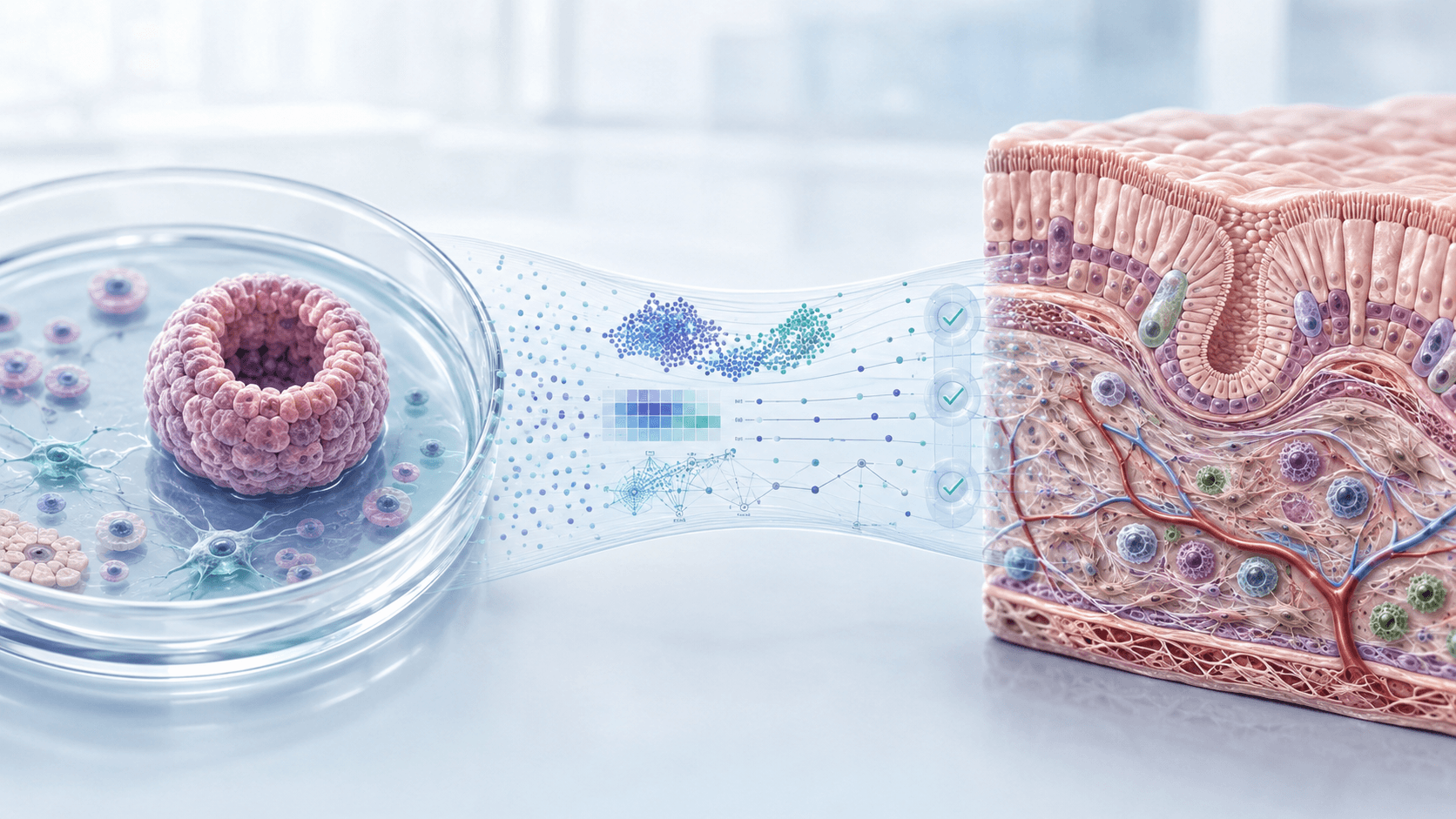
Stem cell biology has crossed an important threshold.
The promise has become practical.
Twenty years after induced pluripotent stem cells (iPSCs) transformed the idea of cellular plasticity, iPSCs now support disease modeling, drug discovery, toxicology, regenerative medicine, and the development of increasingly sophisticated human model systems[1]. Human pluripotent stem cell-derived therapies have also moved from isolated experiments into a real clinical landscape, with more than 100 regulatory-approved trials testing dozens of products across areas such as vision loss, diabetes, Parkinson’s disease, cancer, and other serious conditions[2].
Stem cells solve one of biology’s biggest access problems: they give researchers renewable, patient-specific human cells that animal models and immortalized cell lines often cannot provide. They can capture genetic variation, expose early developmental and disease mechanisms, and provide starting material for cell-based therapies. But they do not automatically solve the fidelity problem. Many stem-cell-derived models are still built in simplified culture formats and may lack the maturity, tissue architecture, mechanical cues, multicellular interactions, and niche signals that shape cells in the body. As Jaenisch and colleagues argued several years ago, the field has matured enough that the most interesting questions are no longer whether stem cells matter, but how to use them responsibly and rigorously[3].
A model is only as good as the question it can answer.
There is a temptation to treat every stem cell-derived system as a generic substitute for human tissue. A model is not automatically good because it is human, three-dimensional, patient-derived, or visually impressive. It is good only if it captures the biology relevant to the question being asked.
That distinction matters in drug development. Reviews of human disease models describe a clear shift toward organoids, bioengineered tissues, and organs-on-chips because traditional preclinical systems often fail to predict human physiology and pathology[4][5]. But these newer systems are not magic. They are approximations.
- Some are better suited for developmental biology than adult disease.
- Some capture tissue architecture but miss immune, vascular, metabolic, or mechanical cues.
- Some improve one aspect of physiology while introducing new sources of variability.
For metabolic disease, stem cell and organoid models are especially promising, but their usefulness still depends on whether they capture the right disease state, maturity level, and drug-response biology[6].
The real question is context of use.
This is where the field needs a sharper vocabulary. Instead of asking, “Is this a good stem cell model?” we should ask, “Good for what?” A model that is appropriate for studying early development may be misleading for adult-onset disease. A hepatocyte-like cell that is useful for pathway discovery may be insufficient for predicting drug metabolism. A cardiac organoid that reveals morphogenesis may not yet support safety pharmacology. The same cell system can be excellent, inadequate, or dangerous depending on the decision attached to it.
This context-of-use mindset is common in engineering and diagnostics, but stem cell biology has not fully absorbed it. We often compare models against broad expectations rather than explicit performance criteria:
- What native tissue or disease state is the benchmark?
- Which functions must be present?
- Which missing features are acceptable?
- How much donor-to-donor, batch-to-batch, or protocol-to-protocol variation can the intended use tolerate?
Without answers to those questions, the field risks confusing biological sophistication with decision readiness.
Complexity raises the bar.
Organoids and organs-on-chips are a good example of how complexity can add biological relevance. They can layer in tissue architecture, fluid flow, multicellular interactions, host-microbiome relationships, and even multi-organ physiology[5]. That is a major advance. But every added layer of complexity also creates a larger burden of characterization. If an organoid contains multiple cell states, the proportions matter. If a chip introduces mechanical force, the response of each population matters. If a disease model includes patient genetics, the difference between donor-specific biology and protocol noise matters.
This means the next frontier is not simply making models more complex. It is making them more interpretable. The best human models will be those whose strengths and weaknesses are mapped clearly enough that scientists can decide when to trust them, when to improve them, and when to choose a different system.
The missing infrastructure is comparative evidence.
Recent advances in single-cell genomics, multi-omics, lineage tracing, molecular recording, and computational modeling are beginning to expose why directed differentiation and reprogramming remain incomplete, heterogeneous, or inefficient[7]. Those tools point toward a new layer of infrastructure for the field: comparative evidence systems that connect engineered cells to the human biology they are intended to represent.
In practice, that could mean:
- Benchmarking engineered cells against human reference atlases.
- Measuring maturity and subtype composition.
- Identifying missing or excess populations.
- Comparing protocols across donors and batches.
- Using gene regulatory models to nominate rational next experiments.
Importantly, this should not be framed as a replacement for functional assays, manufacturing controls, or clinical studies. It is a way to make those efforts better targeted. A functional assay tells us whether a model can do something. A comparative molecular framework helps explain why it can, why it cannot, and what might improve it.
This is the type of space where technologies built around reference mapping, single-cell interpretation, and interpretable perturbation modeling could have an outsized influence. Tools such as Capybara and CellOracle illustrate the direction of travel: measuring cell states at high resolution, comparing them to relevant biological references, and generating testable hypotheses for how to move a system closer to the desired state[8][9]. The broader opportunity is not to claim that computation can solve stem cell biology; it is to make cell engineering less empirical and more evidence-driven.
The field is entering its evidence era.
The next decade of stem cell biology will not be judged only by how many cell types can be generated. It will be judged by how well those cells perform in defined contexts: whether they predict human response, reproduce disease mechanisms, scale reproducibly, mature appropriately, are efficacious in patients, and support decisions that hold up outside the dish.
That is a more demanding standard than the field has historically faced, but it is also a sign of maturity. The promise of stem cells is no longer mainly about possibility. It is about qualification.
Answering that question will require better references, better measurements, better transparency about limitations, and better ways to turn failure modes into design rules.
What the stem cell field needs moving forward is a stronger evidence layer beneath the excitement and promise it has generated over the last two decades. Stem-cell-derived systems should not be judged only by whether they are human, complex, or visually impressive, but by whether they are fit for the specific purpose they are meant to serve. In drug discovery and disease modeling, that means models that capture the biology needed to support better decisions. In regenerative medicine and cell therapy, it means cells with well-defined identity, maturity, safety, function, and consistency. This is the challenge ahead for the stem cell field.