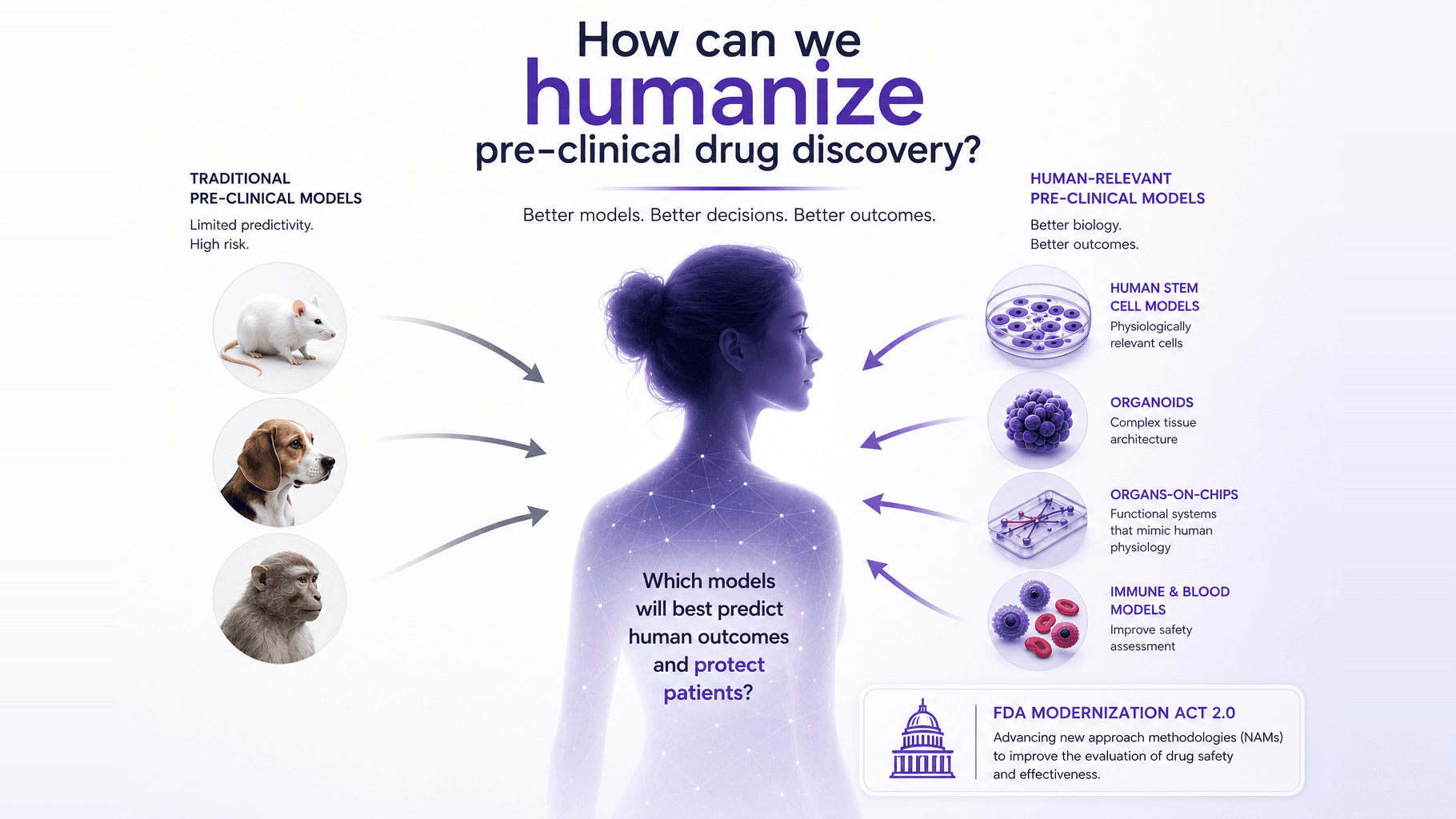
The pharmaceutical industry has a staggering attrition problem: approximately 90% of drug candidates fail to make it through clinical trials[1].
These failed clinical trials can be costly. Sometimes as much as $50 billion to $60 billion, as in the case of failed oncology trials[2]. And on top of the billions in lost capital are the patients who continue to wait for treatments they desperately need.
The cause of this failure can often be traced back to poor pharmacokinetics and toxicity profiles[3].
The limitations of animal models.
- Promising in animals.
- Disappointing in humans.
Typically, animal models have been used to bridge from the pre-clinical stage to the clinical stage, as they can mimic whole-body drug interactions and can be humanized through gene editing to mimic human disease profiles. However, these animal models can only mimic to a certain extent. For example, rat and mice models are the most common model used, but they come with interspecies incompatibilities that make it hard to assume the same outcome will be observed in humans. And, while non-human primates offer a closer alternative, they too cannot fully mimic the human response[3].
Take theralizumab, for example. This monoclonal antibody was developed to treat arthritis and B cell lymphocytic leukemia. Initially pre-clinical studies were done in a B-CLL mouse model[4] before being studied in a non-human primate model for further safety and efficacy testing. Cynomolgus and rhesus monkeys were chosen because the receptor the drug would bind to (CD28) was conserved across the species[5]. However, the phase I trial outcome did not match that of the pre-clinical tests. At a dose significantly lower than what was used in the animal studies, the human participants experienced an immune response called a “cytokine storm” that resulted in organ failure and hospitalization[4][5]. When the matter was investigated by another group, it was found that the receptors that were previously reported to be conserved between humans and the non-human primates were not, undermining the assumption that had justified using primates as a predictive model[6].
The conclusion drawn here should not be that animal models are worthless in the drug discovery process, but that they will not be able to fully recapitulate a human response. There are real interspecies differences that are not always accounted for but can lead to costly side effects.
Stem cell-based model systems may offer a more human-specific solution to the pre-clinical issue.
Induced pluripotent stem cells (iPSCs), embryonic stem cells, and adult stem cells possess the unique capability of self-renewal and differentiation into a wide array of cell types[7]. This allows researchers to study drug interaction with specific organs using 2D and 3D culture, or multi-organ interactions using microfluidic and organ-on-chip devices. And, because they can sometimes be patient-derived, they maintain the same disease mutations of interest[8].
Governing bodies are also catching on to the possibilities of human stem cells in the drug discovery pipeline.
Regulatory momentum: the FDA Modernization Act 2.0.
On December 29, 2022, the FDA Modernization Act 2.0 passed into law. This permitted the use of alternatives to animal testing including iPSC-based cell assays, organoids, organs-on-chips, and AI/ML methods, no longer mandating animal testing[4].
This amendment created a shift in research procedures, opening doors for more human-specific assay development.
There is so much that can be done with human stem cells. From complex multicellular organoids to multiorgan microfluidic devices, and much more. But before researchers can begin to design these assays, they need to ensure that the starting materials used are up to par. A foundation is only as good as the materials used.
As discussed in a previous post, standard quality control metrics for stem cell differentiation do not always provide a complete picture of cell quality. Although differentiated cells may display the expected morphology and express the appropriate marker genes, ensuring that the cells mimic their native tissue as much as possible could produce a more robust pre-clinical model and potentially improve translation outcomes. This discrepancy often reflects the presence of immature or off-target cells within the population, which can reduce differentiation fidelity and introduce bias into downstream assays.
To address these limitations, more comprehensive approaches are needed to assess cell identity and functional maturity.
CapyBio’s Capybara technology analyzes standard single-cell RNA sequencing (scRNA-seq) data to quantify how closely a differentiated cell population matches its corresponding human reference. This approach identifies off-target cell populations and provides a quantitative measure of population purity. When the desired cell identity is not fully achieved, CellOracle can be used to predict and guide regulatory interventions that steer differentiation toward the target cell fate, improving both the efficiency and fidelity of the differentiation process.
Human relevance has to be demonstrated, not assumed.
Animal models have long served as valuable tools in drug discovery, but their ability to predict human biology is inherently limited by interspecies differences. Human stem cell–derived models offer a promising alternative, with the potential to improve the physiological relevance and predictive power of pre-clinical research. Regulatory bodies are also seeing the value of their implementation in the pre-clinical space, and with changes to the governing regulations, a path is being paved to aid in their adoption.
However, realizing that potential requires more than generating cells that look the part; it requires robust differentiation protocols and rigorous validation to ensure cells are truly representative of their intended identity and function. By combining quantitative cell identity assessment with tools to optimize differentiation, CapyBio helps researchers build more reliable stem cell models, enabling greater confidence in downstream discovery and development with the end goal of diverting capital to new therapies that ultimately have a positive impact on the patients who need them most.